
Welcome to the new issue of Grow Your Knowledge Newsletter where you get free, ready to use, actionable, clear information regarding FIDIC Contracts and Construction Claims.
Today at a Glance;
➤ Term of the Week
➤ One Tweet
➤ Proving a Delay Claim is mostly challenging
TERM of the WEEK

ONE TWEET
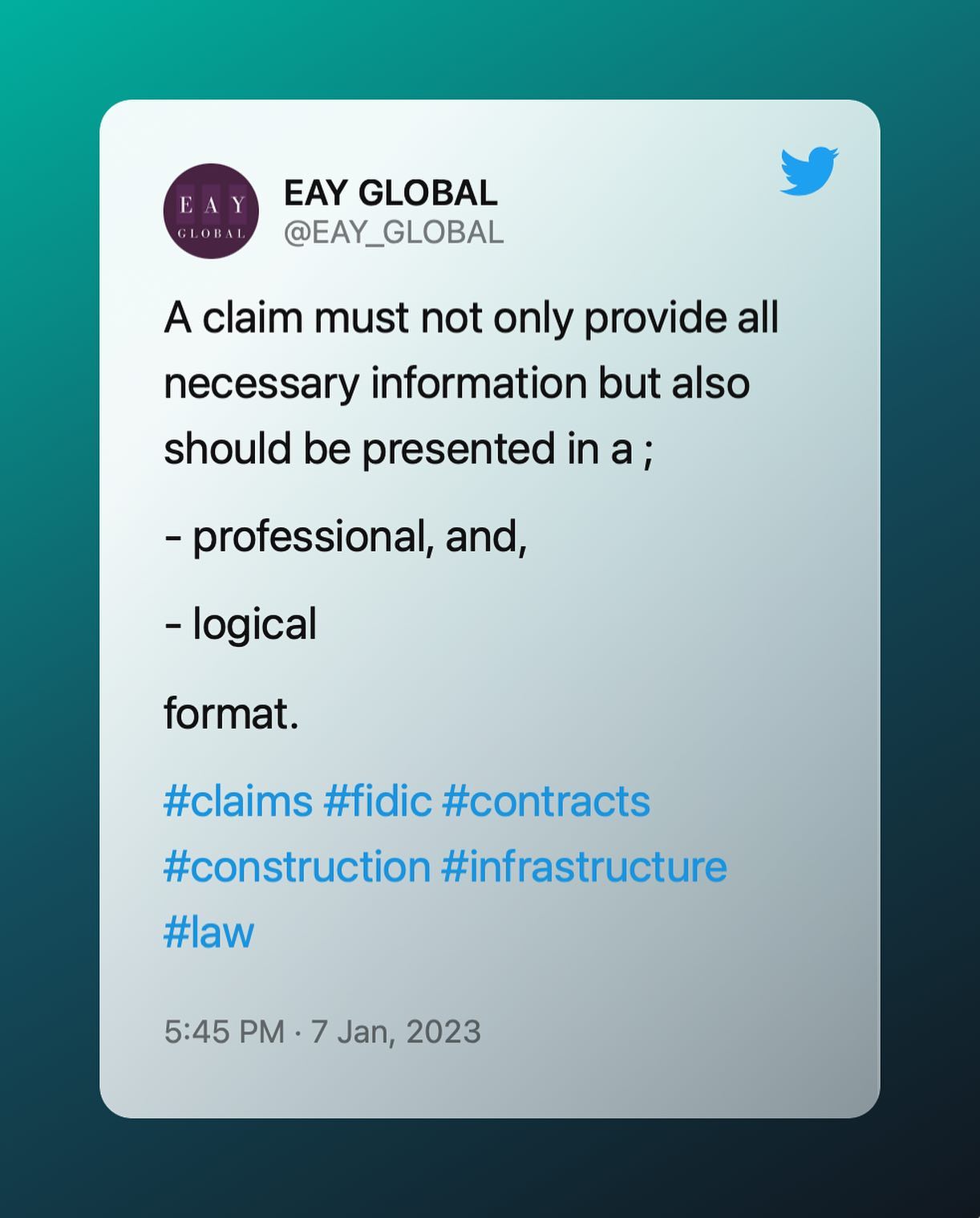
Happy Thursday.
Cost increases are literally locking the construction industry.
Employers suffer too much from that situation.
But it seems the Contractors are a little more in trouble.
*
If you are a Contractor, you will;
➤ Incur significant financial losses
➤ Become insolvent
➤ Lose your capability to perform the contract
due to price fluctuations.
*
But it’s your choice to prevent it or not.
A PRICE ESCALATION CLAUSE is the key.
You should convince the Employer to include a PRICE ESCALATION CLAUSE in the contract.
It’s an excellent tool for sharing the financial risk and securing the project’s performance.
It will bring predictability to the unpredictable market.
*
However, the critical point here is the content of the clause.
It should be;
➤ Determined correctly
➤ Drafted clearly
Otherwise, the price escalation clause will not provide the expected benefit for you.
*
In today’s newsletter, we detailed the key factors that you should pay attention while drafting the clause.
Here’s what we covered;
Factor #1: Clarity regarding the BASE PRICE
Factor #2: Selecting an Appropriate INDEX
Factor #3: DETERMINING the Application of the Price Escalation Mechanism
Factor #4: LIMITING the Application of the Price Escalation Mechanism
Factor #5: The Method for NOTIFYING Price Adjustments
Factor #6: The Level of SUBSTANTIATION required
Factor #1: Clarity regarding the BASE PRICE
You should state whether the Base Price refers to a per-unit quantity or a certain volume of units.
And, you should give the effective month and year of the base price, this time period is often called the Base Period.
Additionally, you should indicate the length of time the Base Price will remain in effect.
Factor #2: Selecting an Appropriate INDEX
The price adjustment clause of a contract should identify the index or group of indexes selected by providing complete titles and identifying codes.
The clause should also cite an appropriate source for the index selected.
Factor #3: DETERMINING the Application of the Price Escalation Mechanism
You should define the triggers for applying the price escalation mechanism.
You should develop a mechanism that will adjust the contract price either up or down depending on input prices to maintain a balanced risk-sharing approach.
The change of the price can be determined by reference to actual costs or commodity indices;
➤ A cost-based clause can measure increases by assessing the difference between the actual cost of materials and the Contractor’s bid
➤ An index-based clause can measure increases in materials, labour or other goods against a specific price index
Factor #4: LIMITING the Application of the Price Escalation Mechanism
You should limit the escalation clause to only those inputs which present the most risk.
The Contractor will be able to protect himself against the most likely price increases.
Thus, the Employer will benefit from paying less contingency risk in the contract price.
Factor #5: The Method for NOTIFYING Price Adjustments
The Clause should enlighten the requirements, such as;
➤ Timing of the Notice
➤ The information it should contain
➤ To whom it should be sent
➤ The proper way of providing Notice
Factor #6: The Level of SUBSTANTIATION Required
You should define the evidence for the cost increases.
The clause should describe the level of supporting particulars.
You should substantiate these increases with dates and prices from the original quote and the current quote.
You should prove the;
➤ Calculations
➤ Demonstrations
related to price adjustments by reference to the;
➤ Project records
➤ Contract
➤ Other supporting evidence
See you next week.
This information is provided for your convenience and does not constitute any “Legal Advice”. This document is prepared for the general information of the interested persons. This should not be acted upon in any specific situation without appropriate legal advice.
This information may not be reproduced or translated without the prior written permission of eayglobal.com
For further information please contact eay@eayglobal.com

![Delay Claims Preparation [Checkpoints]](https://eayglobal.com/wp-content/uploads/2024/05/1-150x150.jpg?crop=1)