



Welcome to the new issue of Grow Your Knowledge Newsletter where you get free, ready to use, actionable, clear information regarding FIDIC Contracts and Construction Claims.
Today at a Glance;
➤ Term of the Week
➤ One Tweet
➤ Presentation of a Delay Claim
TERM of the WEEK


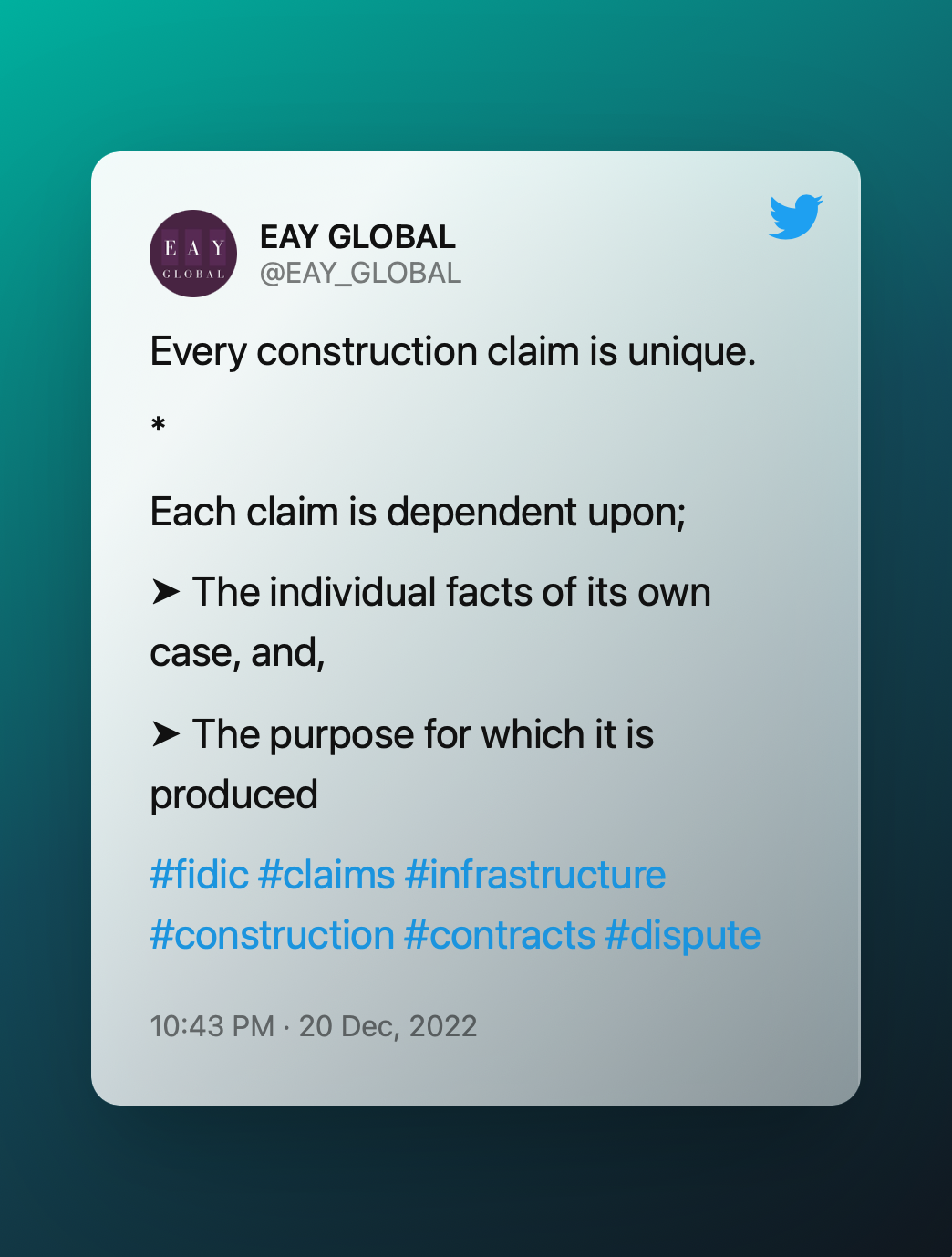
ONE TWEET

Happy Thursday.
A “Delay Claim” is one of the most difficult claims to present.
And, if you fail to present it properly your claim will probably be rejected.
The two factors that are so important in terms of rejection are;
➤ Lack of information that will prevent the Engineer to make the decision
➤ Disagreement with the reasons given for an Extension of Time
However if you clearly;
➤ Understand, and,
➤ Implement
the steps of presenting a delay claim, you can minimise the negative impacts of these two factors.
While presenting the delay claim, you should not forget that each claim is dependent upon;
➤ The individual facts of its own case
➤ The purpose for which it is produced
➤ Separation of what is important and what is not
For an effective presentation, you should design the;
➤ Summary
➤ Body of the claim
➤ Supporting technical arguments and data (Appendix)
in accordance with the circumstances of the delay claim.
Let’s review the steps.
STEP #1: Executive Summary
While preparing the executive summary, you should bear in mind the end user of the claim.
Who is the end user of the claim?
In accordance with that perspective, you should prepare a summary.
Without reading the body of the claim that summary should provide a basic understanding of points and questions such as;
➤ Description of the project
➤ What happened
➤ What you want
➤ Why you are entitled to it
STEP #2: Table of Contents
In this section, you should provide an index of general topics regarding the claim.
STEP #3: Introduction
In this section, you should provide information such as;
➤ What works to be constructed
➤ Parties of the contract
➤ The main reason for the claim preparation
STEP #4: Contractual Framework
In this section, you should describe the Contractual Basis of the Claim.
You should identify the clauses of the contract that entitle you to make a claim.
STEP #5: Actual Conditions and Impact
In this section, you should describe in detail;
➤ The changes in the original conditions
➤ The impacts of these changes
You should identify that;
➤ Particular activities were delayed
➤ By a specific period of time
➤ Which caused (or is likely to cause)
➤ An identifiable delay
STEP #6: Contractual/Legal Entitlement
In this section, you should identify the rights;
➤ For receiving a time extension
➤ Recovering additional compensation
under the contract or law.
You should establish that;
➤ The delay is excusable, and,
➤ The delay is compensable
This section should meet the procedural requirements such as; notice, timely presentation of the claim, updating CPM, time impact analysis and others.
STEP #7: Quantification of Claim
In this section, you should value the delay and cost experienced.
Not correctly understanding the fundamentals of substantiation is one of the causes of unsuccessful claims.
Each Delay Analysis Technique (DAT) has its own limitations and capabilities.
You should choose the most appropriate technique in accordance with the;
➤ Circumstances of the claim, and,
➤ The project
The objective of delay analysis is to;
➤ Calculate the project delay and
➤ Work backwards to try to identify how much of it is attributable to each party so that time and/or cost compensation can be decided.
All the;
➤ Evaluations
➤ Analysis
➤ Methods
➤ Assumptions
should be transparent and clearly explained.
STEP #8: Formal Statement of Claim
In this section, you should present the formal request.
STEP #9: Appendix
➤ Evaluation Reports and Schedules with Supporting Figures
➤ Contract Programmes
➤ Cost Information
➤ Monthly Progress Reports, Meeting Minutes
➤ Photographs
➤ Detailed Estimates
This information is provided for your convenience and does not constitute any “Legal Advice”. This document is prepared for the general information of the interested persons. This should not be acted upon in any specific situation without appropriate legal advice.
This information may not be reproduced or translated without the prior written permission of eayglobal.com
For further information please contact eay@eayglobal.com