


Welcome to the new issue of Grow Your Knowledge Newsletter where you get free, ready to use, actionable, clear information regarding FIDIC Contracts and Construction Claims.
Today at a Glance;
➤ Term of the Week
➤ One Tweet
➤ Termination of an EPC Contract
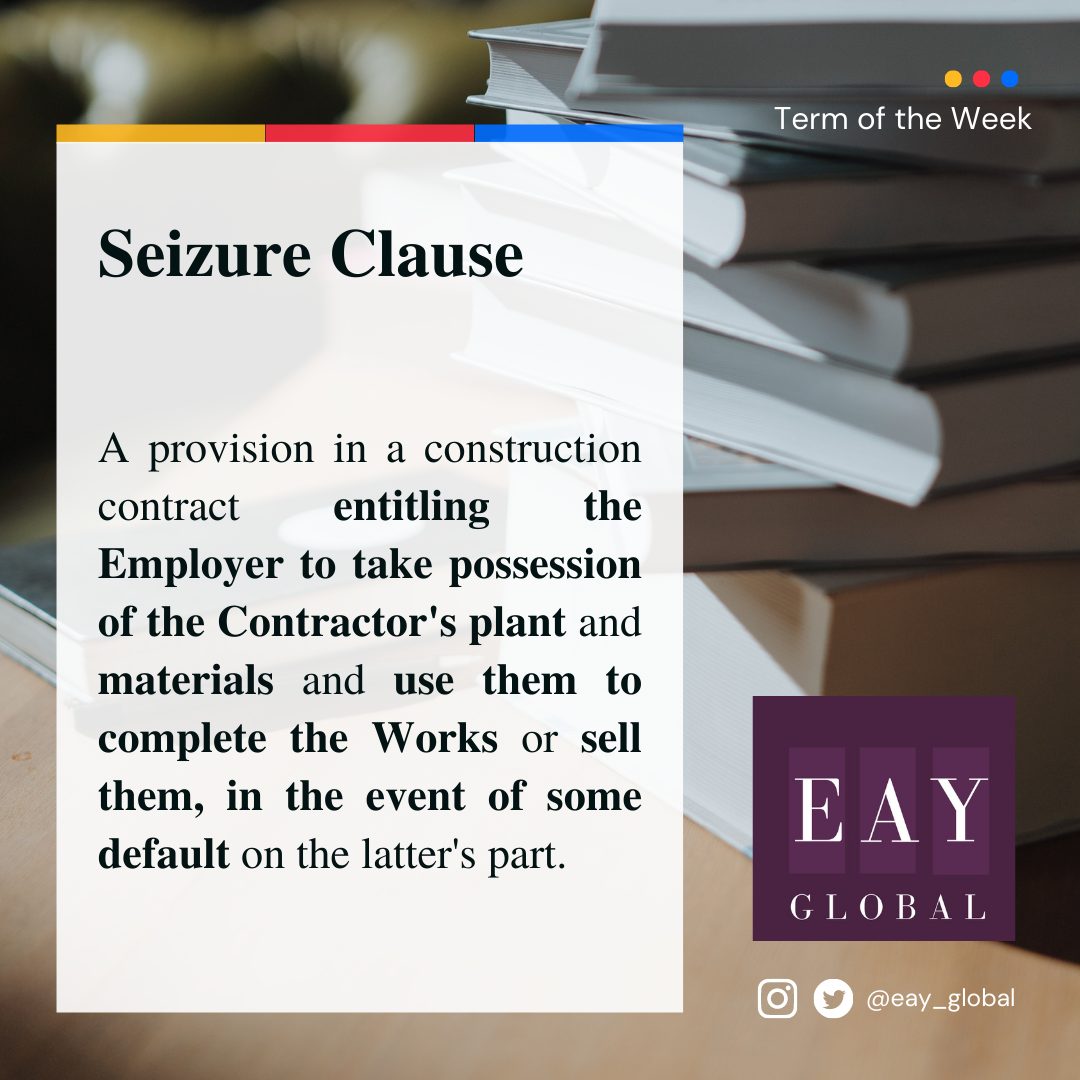
TERM of the WEEK

ONE TWEET


Happy Thursday.
Termination of an EPC contract by the Employer will definitely have serious consequences for the Contractor.
If you are a Contractor, assessment of these consequences will be crucial for you.
However, before doing so, you should determine whether this termination was carried out in accordance with the termination procedures.
*
To find out that, you should clearly answer these 4 questions;
1. Is the Employer entitled to terminate the Contract?
2. Has the Employer complied with the Notice Requirements?
3. Has the Employer’s Representative determined the value of the Works accurately?
4. Has the Employer strictly followed the Payment Procedure?
2017 FIDIC Silver Book provides great guidance for the answers of these questions.
Answer 1: Employer’s ENTITLEMENT to TERMINATE the CONTRACT
The Employer will be entitled to terminate the Contract for;
➤ Contractor’s default
➤ Employer’s convenience
Answer 2: COMPLIANCE with the NOTICE REQUIREMENTS
In case of Termination for Contractor’s Default
The Employer should give;
➤ Notice of the Employer’s Intention to Terminate the Contract
➤ Notice of Termination
*
In case of Termination for Employer’s Convenience
The Employer should give;
➤ Notice of Termination
Answer 3: Accurately DETERMINATION of the VALUE of the WORKS
The Employer’s Representative is to proceed;
➤ In accordance with Sub-Clause 3.5 [Agreement or Determination]
And, the scope of Valuation should be carefully decided.
Answer 4: Strictly FOLLOWING the PAYMENT PROCEDURE
In case of Termination for Employer’s Convenience;
➤ Within 112 days after the Employer receives the Contractor’s submission, the Employer is to pay the agreed amount.
Let’s focus on these answers.
Answer 1: Employer’s ENTITLEMENT to TERMINATE the CONTRACT
The Employer will be entitled to terminate the Contract for;
➤ Contractor’s default
➤ Employer’s convenience
Answer 2: COMPLIANCE with the NOTICE REQUIREMENTS
In case of Termination for Contractor’s Default
Under Sub-Clause 15.2.1 the Employer is to give;
Notice of the Employer’s Intention to Terminate the Contract
If the Contractor [1];
(a) fails to comply with;
(i) a Notice to Correct [2],
(ii) a binding agreement, or final and binding determination, under Sub-Clause 3.5 [Agreement or Determination]; or
(iii) a decision of the DAAB under 21.4 [Obtaining DAAB’s Decision] (whether binding or final and binding)
and such failure constitutes a material breach of the Contractor’s obligations under the Contract.
(b) Abandons the Works or otherwise plainly demonstrates an intention not to continue the performance of the Contractor’s obligations under the Contract.
(c) Without reasonable excuse fails to proceed with the Works in accordance with Clause 8 [Commencement, Delays and Suspension] or, if there is a maximum amount of Delay Damages stated in the Contract Data, the Contractor’s failure to comply with Sub-Clause 8.2 [Time for Completion] is such that the Employer would be entitled to Delay Damages that exceed this maximum amount.
(d) Without reasonable excuse fails to comply with a Notice of rejection given by the Employer under Sub-Clause 7.5 [Defects and Rejection] or an Employer’s instruction under Sub-Clause 7.6 [Remedial Work], within 28 days after receiving it.
(e) Fails to comply with Sub-Clause 4.2 [Performance Security].
Notice of Termination
If the Contractor [3];
(f) Subcontracts the whole, or any part of, the Works in breach of Sub-Clause 4.4 [Subcontractors], or assigns the Contract without the required agreement under Sub-Clause 1.7 [Assignment].
(g) Becomes bankrupt or insolvent; goes into liquidation, administration, reorganization, winding-up or dissolution; becomes subject of the appointment of a liquidator, receiver, administrator, manage or trustee, enters into a composition or arrangement with the Contractor’s creditors, or any act is done or any event occurs which is analogous to or has a similar effect to any of these acts or events under applicable Laws;
or if the Contractor is JV;
(i) Any of these matters apply to a member of the JV, and,
(ii) the other member(s) do not promptly confirm to the Employer
that, in accordance with the Sub-Clause 1.13(a) [Joint and Several Liability], such member’s obligations under the Contract shall be fulfilled in accordance with the Contract; or
(h) is found, based on reasonable evidence, to have engaged in corrupt, fraudulent, collusive or coercive practice at any time in relation to the Works or to the Contract.
In case of Termination for Employer’s Convenience
Notice to the Contractor
The Employer is entitled to terminate the Contract for convenience at any time by giving a Notice of Termination to the Contractor.
Answer 3: Accurately DETERMINATION of the VALUE of the WORKS
In case of Termination for Contractor’s Default
The Employer’s Representative is to proceed, in accordance with Sub-Clause 3.5 [Agreement or Determination], to agree or determine the value of the Permanent Works, Goods and Contractor’s Documents, and any other sums for work executed in accordance with the Contract.
The Valuation is;
➤ to include,
– Additions and/or deductions,
– The balance due if any, by reference to the matters set out in sub-paragraphs (a) and (b) of Sub-Clause 14.13 [Final Payment]
➤ not to include,
– the value of any Contractor’s Documents, Materials, Plant and Permanent Works to the extent that they do not comply with the Contract.
In case of Termination for Employer’s Convenience
The Contractor is to submit detailed supporting particulars of:
➤ The value of work done including;
– The matters set out in sub-paragraphs (a) to (e) of Sub-Clause 18.5 [Optional Termination], and
– The matters described in sub-paragraphs (a) to (b) of Sub-Clause 14.13 [Final Payment]
➤ The amount of loss of profit or other losses and damages suffered by the Contractor.
The Employer’s Representative shall then proceed under Sub-Clause 3.5 [Agreement or Determination] to agree or determine the matters described (2.3.1) above.
Answer 4: Strictly FOLLOWING the PAYMENT PROCEDURE
In case of Termination for Contractor’s Default
Until all the costs, losses and damages set out in the following provisions have been established, the Employer may withhold payment of the amounts due to him under Sub-Clause 15.3 [Valuation after Termination for Contractor’s Default].
After termination pursuant to Sub-Clause 15.2 [Termination for Contractor’s Default], the Employer is to be entitled to payment by the Contractor in accordance with Sub-Clause 20.2 [Claims for Payment and/or EOT] to payment for the;
(a) the additional costs of execution of the Works, and other reasonably incurred costs, after following for any sum due to the Contractor under Sub-Clause 15.3 [Valuation after Termination for Contractor’s Default].
(b) losses and damages suffered in completing the Works.
(c) Delay Damages.
In case of Termination for Employer’s Convenience
Within 112 days after the Employer receives the Contractor’s submission, the Employer is to pay the agreed amount.
[1] The same Sub-Paragraph letters are used as in Sub-Clause 15.2 [Termination for Contractor’s Default] of the 2017 FIDIC Silver Book.
[2] Sub-Clause 15.1 [Notice to Correct]; If the Contractor fails to carry out any obligation under the Contract the Employer may, by giving a Notice to the Contractor, require the Contractor to make good the failure and to remedy it within a specified time.
[3] The same Sub-Paragraph letters are used as in Sub-Clause 15.2 [Termination for Contractor’s Default] of the 2017 FIDIC Silver Book.
See you next week.
This information is provided for your convenience and does not constitute any “Legal Advice”. This document is prepared for the general information of the interested persons. This should not be acted upon in any specific situation without appropriate legal advice.
This information may not be reproduced or translated without the prior written permission of eayglobal.com
For further information please contact eay@eayglobal.com