Some failures will inevitably make your claim unsuccessful.
Not perfectly understanding what your contract says is one of these common failures.
Below, you can find the contractor claims-related clauses under the 2017 FIDIC Red Book.
Your Extension of Time (EOT) claim is rejected.
You believe that the EOT claim you have submitted was effective and valid.
You think you have;
➤ Accurately defined the CAUSES of the delay event
➤ Perfectly explained the EFFECTS of the delay event
➤ Correctly established the contractual ENTITLEMENT
➤ Sufficiently SUBSTANTIATED the claim
Let’s talk about the poor presentation of a variation claim and how it negatively impacts the success of your claim.
A poorly presented variation claim;
➤ Forces the Engineer to reject the claim, or,
➤ Prevents the Engineer from making decisions due to a lack of information
Developing and implementing a claim preparation strategy is vital for the success of the claim.
When we don’t learn to accept that fact, our claims inevitably fail.
Without the right strategy, we are disconnected from the fundamentals of the claim.
It is essential to follow a comprehensive approach that considers all aspects of the claim preparation.
Variation is a process that puts a significant financial burden on the Contractor if not well managed.
What triggers variation will be different for each case based on the own facts of the project.
The nature of the works, the complexity of the project, the ever-changing needs of the Employer, the lack of detail at the pre-contract stage and unexpected developments are some of the triggers for variation.
A perfect “Delay claim” isn’t something everyone is capable of preparing.
Some delay claims don’t contain the essential elements or have an appropriate framework.
So, every submitted claim doesn’t mean that it has a good chance of success.
It’s important to understand that, claims get results most definitely because of their accurate structures and functions.
Your claim will fail if you cannot clearly determine the cause of the claim event.
Additionally, without identifying the cause you cannot develop the correct link between the;
➤ Claim event and the damage or delay
in other words;
➤ Cause and effect


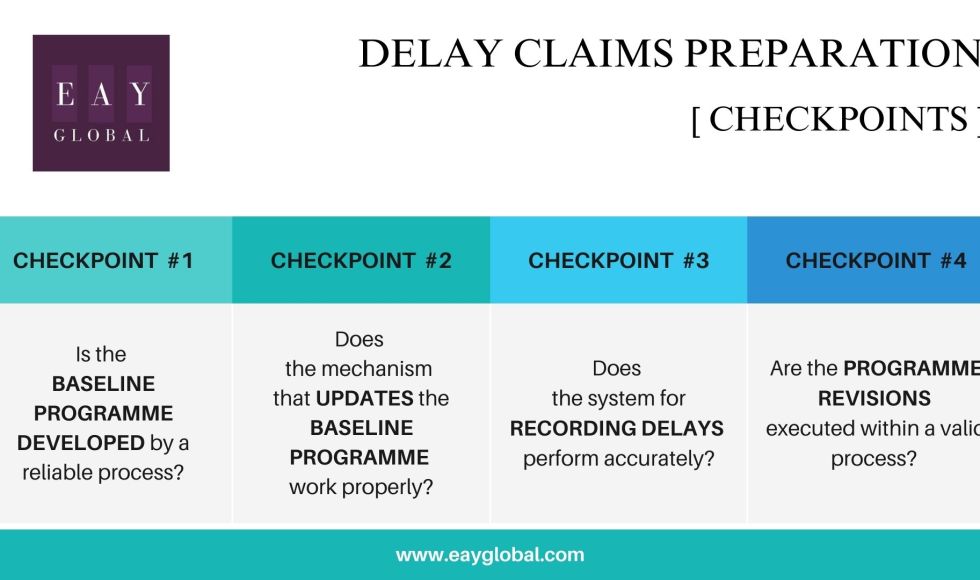


![Delay Claims Preparation [Checkpoints]](https://eayglobal.com/wp-content/uploads/2024/05/1-150x150.jpg?crop=1)